- Algae are champions in converting sunlight to biomass
- Algae can grow in fresh and salt water
- Algae don't need fertile land
- Algae are rich in proteins, fats and other interesting components

http://www.proviron.com/algae/GB/index_GB.php
- Algae are champions in converting sunlight to biomass
- Algae can grow in fresh and salt water
- Algae don't need fertile land
- Algae are rich in proteins, fats and other interesting components
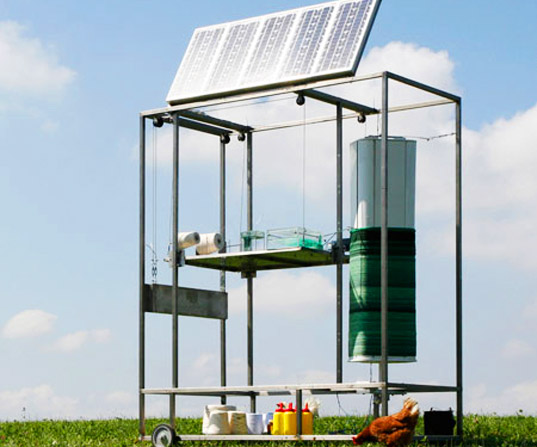
Austrian designers mischer’traxler have created a solar powered machine that makes an incredible array of furnishings that vary based on how much sunlight it receives over the course of a day. Titled “The Idea of a Tree“, the machine spins spools of thread into stools, benches, containers, and lamp shades that wax and wane as the available sunlight shifts. Variations in weather, the time of year, and other environmental factors create pieces of different shape, color, and size, instilling the furniture with growing, seasonal qualities that mimic photosynthesis.
"IT’S UP TO SOCIAL SCIENCE TO MAKE US ACT IN AN ENVIRONMENTALLY CONSCIOUS WAY. BUT CAN WE TRICK OURSELVES INTO SAVING OURSELVES?" - article by David Zax in Seed Magazine, talking about the "Last Experiment":
"Residents of a community were shown how their energy use measured up against the communal average. If they consumed more than the average, most reduced energy in the months ahead. If households saw that they consumed less energy than their peers, however, their energy use actually rose, except when the frugal households were given the merest of rewards: a smiley face on their bill."
Huey-Dewey-Louie Climate Clock
It might be worth considering the surrounding of the proposed site as this could make a big difference to the way in which your artwork is perceived.
I think I've already mentioned 'Democracity' and the work of Eddie Bernays the link shows some images, not the best but will illustrate my point. This was in 1939 at a time when most people were sceptical about capitalism's future, after the great depression and the very ideas of Democracy were, for the most part, considered inadequate. What Bernays did saved both by presenting an idealistic vision of the future which he called 'Democracity' in which capitalism and Democracy were presented in such a way that would 'save the world' and at the same sate the needs and desires of the masses, and people warmed to it.
Ok, I know that this type of thing is outside the remit of this project, but careful selection of the site could capitalise on existing venues for example, somewhere like Olympia and The NEC, where trade fairs, exhibitions and conferences regularly take place and where green technology could be shown at the opening, it would raise revenue for our hosts, develop the climate change issue and turn the whole thing into a mega event with your artwork as a focal point and you would effectively have “Democracity”
Looking beyond the artwork to the climate change issue, it would be possible to create a much wider context and such a site would, if developed, take on a new identity becoming known as the centre for addressing climate change and this would have a powerful effect on public perception.
See the documentary 'The Century of the Self' on how Bernays created Public Relations and think about the implications to promotion of these ideas.
Something to think about
My thanks
Caroline
Huey-Dewey-Louie Climate Clock
An homage to the film 'Silent Running'
This project, one of the three finalists in the ideas competition organised by the Climate Clock Initiative, San Jose, is a proposed self-building landscape that measures and tracks climate change, both local and global, over the course of the next 100 years. The concept and technical design will be further developed over the next couple of years, in particular during a residency at FUSE:cadre.

Our basic assumptions:
The Clock consists of three characters that construct themselves over the course of days, months & years forming a highly legible landscape record of climatic change & possible causes of this change. Biological materials are extracted directly from the environment to facilitate ongoing and future analyis.
Huey-Dewey-Louie Climate Clock after 14 years...

I. Accretion Mounds: Huey
Autonomously accreted daily from light & dark materials extracted chemically from the atmosphere, the thickness of each carbonised/calcareous layer is proportional to the degree of fluctuation of local environmental parameters, visible, like tree-rings, via colour gradations of the deposited material. The geometric trend of the stratigraphic conic structure is dependent upon measurements of climatic change so that, viewed from below, the sky is visible until its completion, at which point the date will indicate the relative 'health' of the global weather system - the later it closes each year the better the global ecosphere's 'health'.

II. 3m3 Samples: Dewey
Round the site will be 100 plinths onto which will be placed annually a sample of air hermetically preserved in a transparent box measuring 3m x 1m x 1m. At Year 0, 10,000 daffodil seeds will be cloned from a single genetic sample. Each year, 100 will be planted on site; at year-end, a single flower and 99 compacted into a block will be placed at the base of the sealed sample columns. The way this preserved plant material, genetically identical through 100 years, responded to its year's changing climatic situation, and the air samples, will provide useful material for future analysis.

III. Cubic Data Packer: Louie
An autonomous machine, powered by solar panels & heat engine, grazes round the site moving 1 cm/day, guided by local temperature & wind conditions. It extracts local soil via helical blades & fuses this daily into small cubes, each face of which is stamped with a date & environmental or economic measurements chosen by daily popular public vote, including e.g. global CO2 level, atmospheric methane, rainfall, price of corn, or index of light crude oil - whatever contemporary humans determine to be important. The cubes through their encoded positions record both local & global daily environmental conditions.
